


Coffin fingernails are one of the most requested shapes in salons, and one of the most misunderstood. People ask for them with nails that are too short, file the sides too far down, and then wonder why a corner snaps off two days later.
This guide fixes that. You will learn what the shape is, where the name comes from, how many millimeters of free edge you need, how it compares with almond, and how to file coffin nails at home with a simple numbered method.
Quick answer: Coffin nails are a nail shape with straight sides that taper in toward a flat, squared-off tip. The outline looks like a coffin lid, and the shape is also called ballerina. You need at least 3 mm of free edge to see the taper, and 6 mm or more for the classic look.
☰ Jump to a section12 sections
- What Are Coffin Nails?
- Coffin vs Ballerina Nails: Same Shape, Two Names
- How Long Do Your Nails Need to Be for Coffin Nails?
- Coffin Nails vs Almond Nails
- Who Coffin Nails Suit
- Natural Nails vs Acrylic, Gel and Press-Ons for Coffin Nails
- How to File Coffin Nails Step by Step
- How to Keep Coffin Nails From Breaking
- Coffin Nail Ideas to Try
- Frequently Asked Questions
- Getting Started With Coffin Nails
- Sources
What Are Coffin Nails?
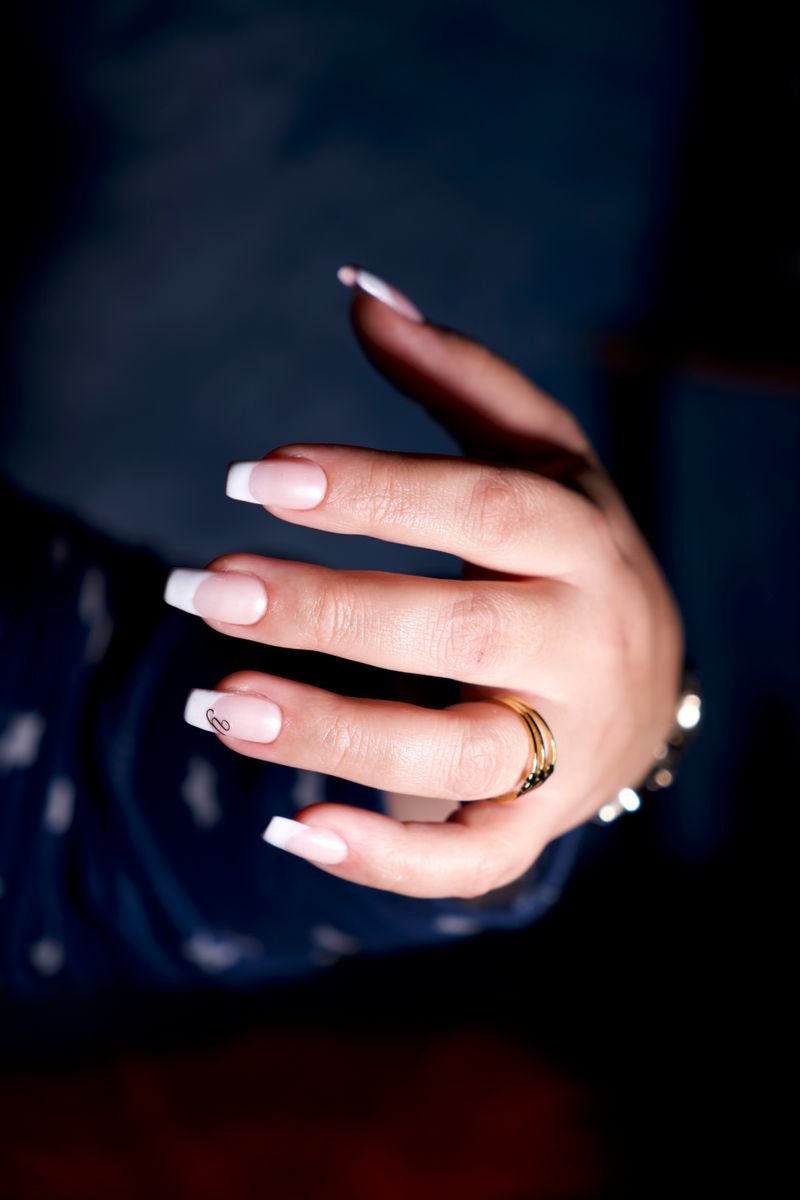
A coffin nail has straight sides that angle inward as they leave the finger, and a flat end with two small corners.
That flat end is what separates coffin from shapes like almond and stiletto, which close into a point. The straight taper is what separates it from square, where the sides stay parallel all the way up.
The taper only happens on the free edge. That is the part of the nail that grows past the skin at your fingertip. Your nail anatomy matters here: the nail plate over the nail bed stays its natural width, and all the shaping happens beyond the smile line, where the nail turns white.
You can wear coffin fingernails short, medium or very long. The shape works on natural nails, acrylic, gel and press-ons. If you are still choosing between shapes, our full guide to every common nail shape lays them all out side by side.
Coffin vs Ballerina Nails: Same Shape, Two Names
Coffin and ballerina are two names for one shape. Salons use both, and press-on packs often print both on the box.
Why “Coffin”?
Picture a coffin seen from above. It is wide at the shoulders, narrows toward the feet and ends flat. A coffin nail has the same outline: wider at the nail bed, narrower at the tip, flat across the end.
Why “Ballerina”?
The second name comes from the ballet pointe shoe. The toe of that shoe has a rigid box, and the front of the box is flattened into a small platform the dancer balances on. A coffin nail ends the same way: a narrow, flat platform at the tip.
Some nail techs use “ballerina” for a version with a gentler taper and slightly softened corners. If you want that softer finish, say so in words rather than relying on the name.
How Long Do Your Nails Need to Be for Coffin Nails?
Length is where most coffin attempts go wrong. Measure the free edge only, starting at the point where the nail leaves the skin of your fingertip. Do not measure the pink part.
With less than 3 mm of free edge, there is nothing to taper. The nail ends up looking square with slightly narrow corners. Here are the ranges I work with:
| Coffin length | Free edge past fingertip | How it looks | Natural nails? |
|---|---|---|---|
| Minimum | 3 mm | A slight taper, tip still fairly wide | Yes |
| Short coffin | 3 to 5 mm | Neat and wearable, taper visible up close | Yes, if your nails are healthy |
| Medium coffin | 6 to 10 mm | The classic coffin outline, clear taper | Possible with strong nails; gel or acrylic helps |
| Long coffin | 11 to 15 mm | Dramatic, very slim tip | Rarely; usually acrylic, hard gel or press-ons |
| Extra long | 16 mm and up | Statement length | No; extensions only |
Fingernails grow about 3.5 mm a month on average. So if you are starting with nails clipped flush to your fingertip, plan on about 4 weeks to reach the minimum and about 2 to 3 months for a medium coffin on your own nails. Age, diet and season all change that speed a little.
Coffin Nails vs Almond Nails
These two get compared more than any other pair, because both taper and both make fingers look longer. The difference sits at the tip. Coffin ends flat. Almond ends in a soft, rounded point.
| Feature | Coffin | Almond |
|---|---|---|
| Tip | Flat, with two small corners | Rounded point, no corners |
| Sides | Straight lines angled inward | Gentle curves that meet at the top |
| Strength | Medium; the corners can catch and chip | Medium to good; no corners to snag |
| Best length | 6 mm or more of free edge | 4 mm or more of free edge |
| Best hands | Long fingers, narrow to medium nail beds | Short fingers, wide nail beds, most hands |
| Look | Bold, modern, a lot of flat space for nail art | Soft, polished, classic |
Pick almond if you want a slimming taper that survives daily life better. Pick coffin if you want more surface for designs, like ombré, chrome or a French tip with a straight line. Soft finishes such as soft chrome show up well on the wide, flat end of a coffin.
Not sure which suits you? Our nail shape finder tool asks a few questions about your fingers and nail beds and suggests a match.
Try the free Nail Color Matcher
See which polish colors suit your skin tone. Free, no sign-up.
Who Coffin Nails Suit
Coffin is a confident shape, and it looks best when your hand gives it room. Put your hand flat on a table and check two things: the length of your fingers and the width and length of your nail beds (the pink part).
| Your hands or nails | How coffin works | What to ask for |
|---|---|---|
| Long, slim fingers | Very well at any length | Any coffin you like |
| Long nail beds | Very well; the taper looks balanced | Short or medium natural coffin |
| Narrow nail beds | Well, but the tip can get too thin | Light taper so the tip stays at least half the base width |
| Wide nail beds | Works with medium length | Medium length with a clear taper to slim the nail |
| Short fingers | Works if the nails are medium or longer | Medium coffin; skip very short versions, which read as square |
| Short or small nail beds | Harder; little room to shape | Extensions, or try almond first |
| Nails that fan out wider at the tip | Difficult on natural nails | Gel or acrylic so the tech can build the taper |
Lifestyle matters as much as hand shape. If you type all day, cook, garden or work in healthcare, a short coffin or a different shape will be easier to live with.
Natural Nails vs Acrylic, Gel and Press-Ons for Coffin Nails
Your own nails can hold a short coffin. Once you go past about 10 mm of free edge, most people need extra strength. Here is how the options compare for this shape.
| Option | Strength at coffin length | How long it lasts | Upkeep | Cost level |
|---|---|---|---|---|
| Natural nails | Low to medium; best for short coffin | Until it chips or grows out | Reshape every week or two | $ |
| Acrylic | High; holds long, slim tips | Up to about 3 weeks | Fills every 2 to 3 weeks | $$ to $$$ |
| Gel (hard gel or soft gel tips) | Medium to high; more flexible than acrylic | 2 to 3 weeks | Fills or a new set every 2 to 3 weeks | $$ to $$$ |
| Press-ons | Medium; depends on fit and glue | About 1 to 2 weeks with glue, a few days with adhesive tabs | Reapply when a nail lifts | $ |
The wear times for acrylic and gel come from the overview of artificial nails, which also lists ballerina/coffin among the standard shapes for enhancements. The American Academy of Dermatology notes that artificial nails worn for more than a few weeks need touch-ups every 2 to 3 weeks, and that frequent touch-ups can seriously damage natural nails. Dermatologists also suggest soak-off gel over acrylic because gel is more flexible, so the nail underneath is less likely to crack.
Press-ons are the easiest way to test the shape before you commit. Coffin is one of the most common press-on shapes, and our Halloween press-on nails picks include several coffin sets. When a gel or dip set comes off, remove it properly. Picking it off strips layers of your own nail. Our guides on getting gel polish off and removing dip nails at home walk you through it.
How to File Coffin Nails Step by Step
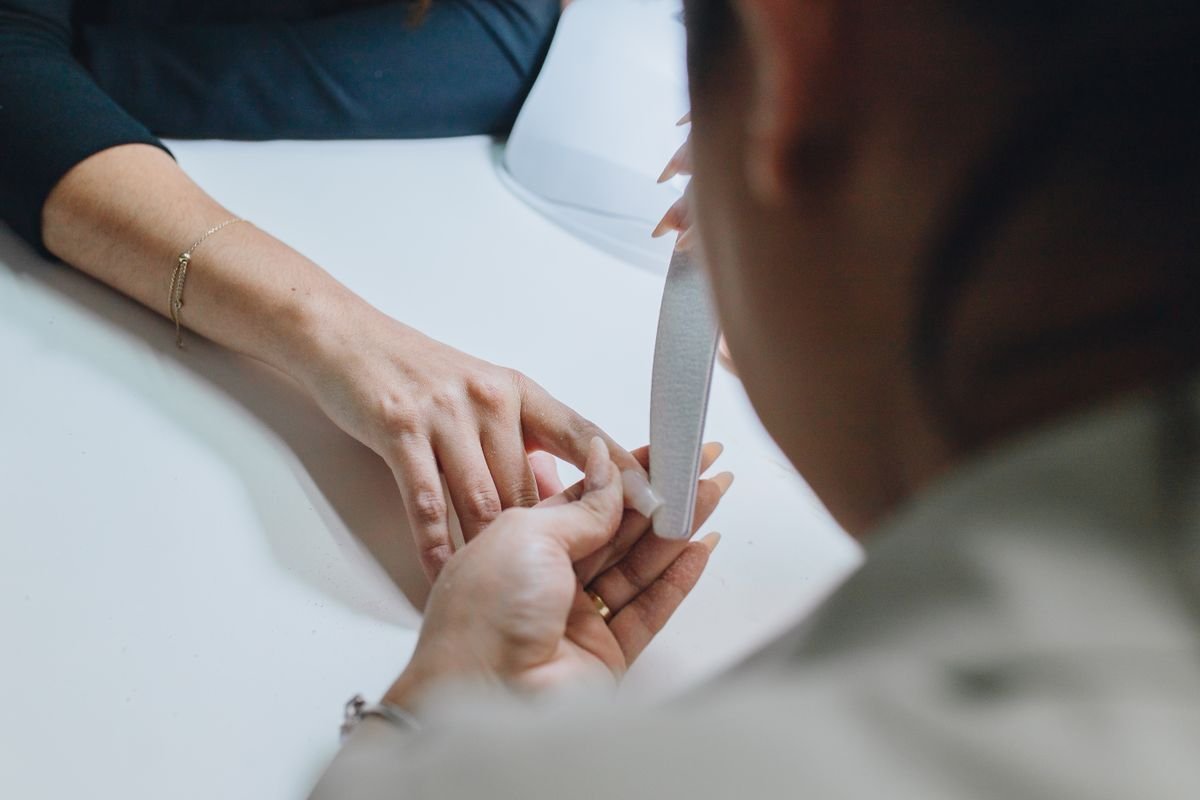
You can file coffin fingernails at home in about 15 to 20 minutes for both hands. Go slow on the first try. You can always file more, but you cannot put length back.
Tools You Need
- Nail clippers
- A 180-grit file for shaping, or a glass file (gentler on natural nails)
- A 240-grit buffer or fine file for smoothing
- Cuticle oil or a hand cream
- Base coat
Start with bare, dry nails. Wet nails bend, and you can over-file them without noticing.
The Steps
- Clip to length. Leave about 1 mm more than the length you want. Filing takes off more than you expect.
- File the tip straight across. Hold the file flat against the end of the nail and make a clean, straight edge. You now have a square nail.
- Plan the taper. Look at the nail and pick where the tip will end. On natural nails, keep the flat tip at about half to two thirds of the nail’s width at the smile line. A thinner tip breaks.
- File the first side. Place the file at the side of the free edge, angled in toward the center line. Stroke in one direction only, toward the tip, and lift the file between strokes. The American Academy of Dermatology says filing back and forth can weaken your nails.
- Stop at the smile line. Only shape the free edge. Do not file into the side of the nail where it attaches to the skin. That area takes the most stress, and thinning it is the number one cause of side breaks.
- Match the second side. Use the same angle and the same number of strokes. Turn your hand over and look at the nail with your palm facing you. Both sides should look like mirror images.
- Square the tip again. Tapering narrows the tip and often tilts it. Run the file flat across the end one more time so it is level.
- Soften the corners slightly. One light stroke on each corner takes off the sharp point so it will not catch. Keep the tip flat.
- Smooth and seal. Run the buffer under the tip and along the edges to remove fraying. Wash your hands, then apply base coat and swipe it across the very end of the nail to seal the edge. Finish with cuticle oil.
How to Keep Coffin Nails From Breaking
The two corners and the narrowed sides are the weak spots on this shape. These habits keep them in one piece.
- Taper the free edge only. Leave the sides of the nail bed at full width. This one habit prevents most breaks.
- Do not go too slim. A tip narrower than half the base width on a natural nail bends and splits.
- Seal the tip every time you polish. Run base coat and top coat over the free edge. Re-apply top coat every 3 to 4 days on regular polish.
- Fix snags right away. Carry a small file. A tiny chip in a corner grows into a crack within a day or two if you ignore it.
- Wear gloves for chores. The AAD warns that too much water weakens nails and can cause splitting, peeling and breaking. Gloves for dishes and cleaning help a lot.
- Stop using your nails as tools. Opening cans or scraping labels with your nails causes chips, splits and lifting.
- Moisturize daily. Rub oil or cream into nails and cuticles after you wash your hands. Dry nails split more easily.
- Keep up with fills. On acrylic or gel, a grown-out set shifts weight toward the tip, which puts strain on the corners. Book fills every 2 to 3 weeks.
- Do not pick at chipped gel. Dermatologists advise against peeling gel off. Have it removed or soak only your fingertips in acetone, which should loosen the gel in about 15 minutes.
Our nail color guide and the rundown of types of nail polish can help you pick a finish that lasts on a shape with corners.
Coffin Nail Ideas to Try
Coffin nails give you a long, flat surface, so they suit nail art, French tips, ombré and chrome better than most shapes. Here are 15 real coffin designs to save for your next appointment.
Frequently Asked Questions
Are coffin nails still in style?
Yes. Coffin is a standard shape on salon menus and in press-on packs, so you can find it anywhere. Short and medium coffin with soft colors are the most worn versions right now, while very long coffin is more of a special-occasion look.
Do coffin nails break easily?
They break more easily than round or squoval nails because of the two corners and the narrowed sides. Most breaks come from filing into the sidewalls or tapering the tip too thin. Keep the taper on the free edge, seal the tip with base and top coat, and they hold up well.
Can short nails be coffin?
Yes, if you have at least 3 mm of free edge past your fingertip. At that length, keep the taper light so the tip stays wide. Below 3 mm, the nail will look square, so let it grow for a few weeks first.
What is the difference between coffin and square nails?
Both have a flat tip. Square nails keep the sides straight and parallel, so the tip is as wide as the nail bed. Coffin nails angle the sides inward, so the tip is narrower than the base.
Are coffin and ballerina nails the same thing?
Yes, they are one shape with two names. “Coffin” comes from the outline of a coffin, and “ballerina” comes from the flat tip of a ballet pointe shoe. Some techs file ballerina with softer corners, so describe the corners you want.
How do I ask my nail tech for coffin nails?
Say “coffin” or “ballerina” and show a photo of the exact look. Give the length in a clear way, such as “about 5 mm past my fingertip” or “a quarter inch past the tip.” Then say how slim you want the tip, whether you want sharp or softened corners, and whether you want acrylic, gel or your natural nails.
Getting Started With Coffin Nails
Start short. Grow at least 3 mm of free edge, file a light taper with a flat tip, and wear it for two weeks before you go longer. If it holds without corner chips, add length a few millimeters at a time. If it keeps breaking past 10 mm, switch to gel or acrylic for the extra length, or test the look with press-ons first. Keep the taper on the free edge, file in one direction, and seal the tip, and your coffin nails will last.
Sources
- How to trim your nails (American Academy of Dermatology)
- 11 dermatologists’ tips for healthy nails (American Academy of Dermatology)
- Artificial nails: Dermatologists’ tips for reducing nail damage (American Academy of Dermatology)
- Gel manicures: Tips for healthy nails (American Academy of Dermatology)
- Artificial nails (Wikipedia)
- Nail (anatomy) (Wikipedia)
- Pointe shoe (Wikipedia)

1 thought on “Coffin Nails: The Complete Guide to Coffin Fingernails”